The spaceflight environment entails the adaptation of the human body and the physiological deconditioning in astronauts due to microgravity and absence of protection from the Earth atmosphere. The negative effects on the musculo-skeletal, cardiovascular and vestibular systems are so significant that even short-duration space mission can lead to muscle atrophy and bone demineralization.
Among the different countermeasures being explored, neuro-muscular electrostimulation represents a promising area of research. In this context, the smart biosuit EMSi_MK.02 is being developed by REA Space, an innovative start-up alumni of I3P and ESA BIC Turin, under a contract signed with the Italian Space Agency (ASI).
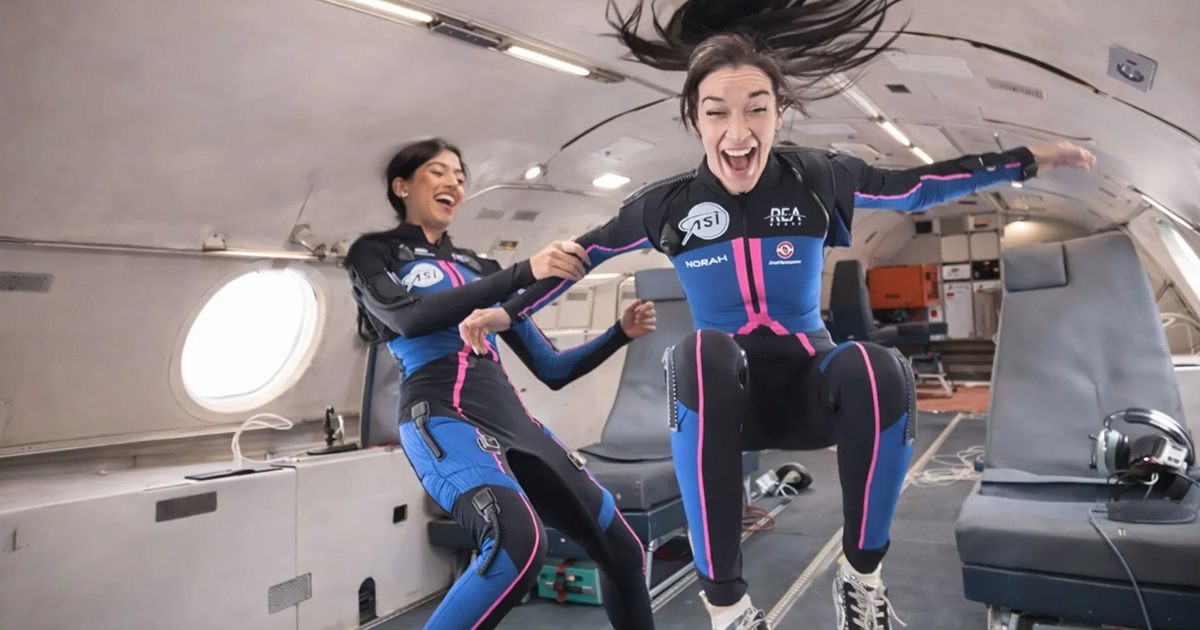
This new wearable device is designed to be able to “read” the astronaut’s movement via bidirectional biomechanical sensors and 12 integrated elettromyography sensors, which are responsible for the real-time adaptive neuromuscular electrostimulation on 48 sites distributed on the astronaut’s body, amplifying the benefits of the physical training the astronauts endure while in microgravity and providing the feeling of being able to move as they were on Earth.
In order to test the biosuit fit, the components and the EMG data acquisition, REA Space has carried out a parabolic flight test in Ottawa, Canada, together with the International Institute for Astronautical Sciences (IIAS) with research astronauts Norah Patten and Shawna Pandya.
More in particular, the test was carried out on connectors and latest-generation electronics, firmware, interchangeable electrodes and fire-retardant materials with antibacterial, bacteriostatic, antistatic and thermoregulating capabilities which will improve the comfort of long-duration missions in the isolated environment of space stations. The results have shown architectural solidity and the ability to acquire data in microgravity, key steps for the next development stages.
On May 2025, REA Space unveiled the first modular EVA space suit, Futura Suit, at EXPO 2025 in Osaka, part of a growth path that the start-up is pursuing, thanks in part to the contribution of the Italian Space Agency, to transform research into concrete solutions, ready to face the challenges of long-duration space missions.